
The Journey to Individualization: Part Two
by Vish Ramkissoon | Thought Leadership
Part Two: The Reality We’re Facing
The reality is that individualization is not only a technology purchase. It is a coordinated operating capability. One of the clearest ways to assess your organization’s maturity is to stop looking at the technology stack and start experiencing the brand from the customer’s perspective.
There’s one warning sign to watch for, and it’s fairly simple: if the customer can see the seams the organization believes it has eliminated. Email may know one thing, the website another. Paid media may continue promoting a product immediately after a purchase. The call center may have no awareness of the digital journey that preceded the call. Each interaction may be optimized, yet the total experience still feels disconnected. You think it’s seamless, but the customer knows otherwise.
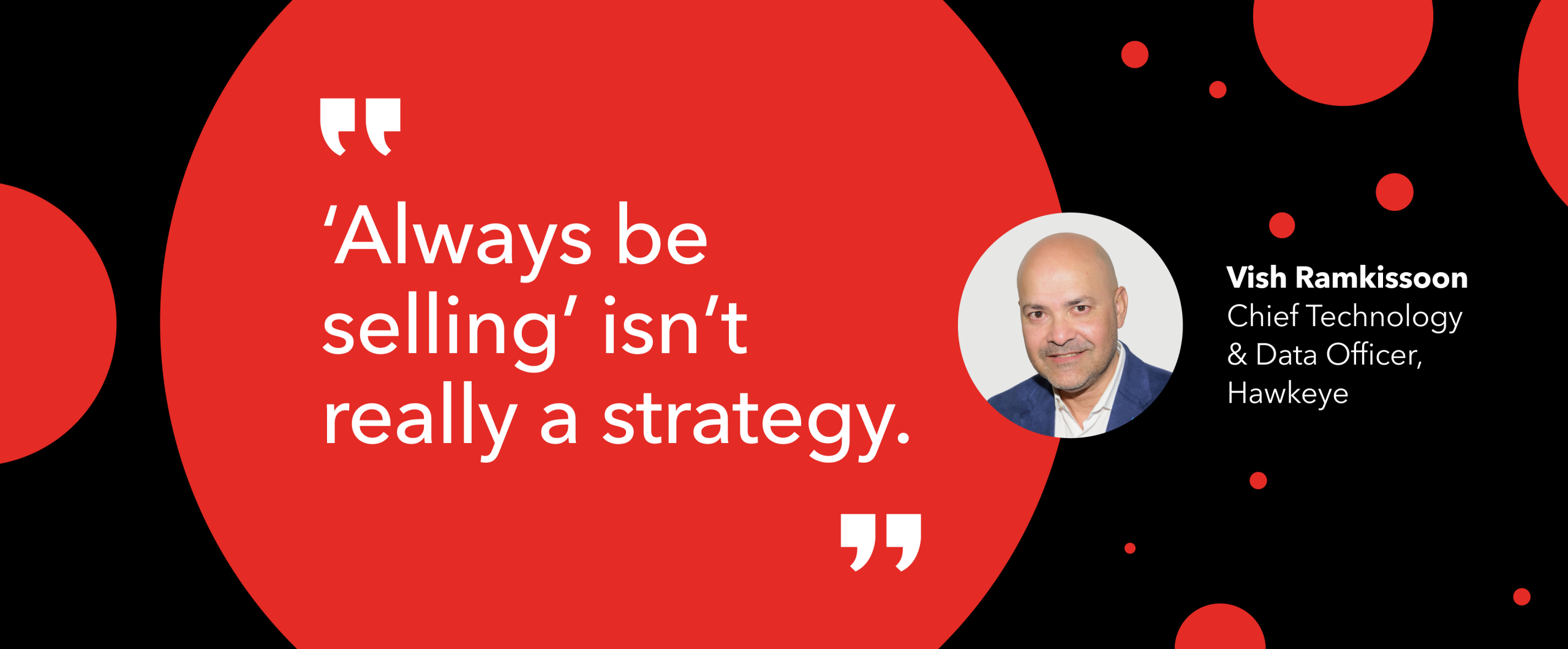
‘Always be selling’ isn’t really a strategy.
This often happens because organizations optimize campaigns rather than customer journeys. Teams can articulate their CRM strategy, media strategy, CRM strategy and commerce strategy, but struggle to explain how those interactions work together for one individual. Even “next best action” can be misleading if it really means “next best offer.” Individualization sometimes means selling, but it can also mean education, service, reassurance or choosing not to communicate at all.
The maturity gap also appears in how decisions are made. If every personalized experience traces back to “customer belongs to segment X, therefore show message Y,” the organization may have sophisticated targeting, but it has not achieved individualization. And if decisions are driven by the brand’s campaign calendar rather than by changing customer behaviour, the gap becomes clearer.
A useful test for maturity is this: does the customer experience the brand as one intelligent entity, or as a collection of sophisticated departments?
The perfect storm that marketers now face.
This matters more now because three powerful forces are converging: customer expectations are increasing, attention is becoming scarcer and technology is catching up with the ambition. Customers increasingly interact with companies that remember their preferences, anticipate what they need and remove unnecessary friction. Those experiences reset expectations for every other organization. The customer’s most recent exceptional experience with a brand sets the standard for every other brand.
At the same time, the economics of mass communication are deteriorating. There is more content, more advertising and more competition for a finite amount of attention. Simply sending more messages is not a sustainable growth strategy. Relevance becomes a strong competitive advantage: knowing when to engage, what to say, which experience to provide and – honestly – when not to communicate at all.
What’s more, AI changes the equation because it begins to remove one of the biggest constraints: the economics of creating and orchestrating millions of genuinely different experiences. Machine learning can interpret signals and support decisioning at scale. Generative AI can expand the ability to create, adapt and assemble content for individual contexts. But AI does not remove the need for strategy, structure or discipline. In many cases, it makes maturity more important because organizations need the right foundations to use these capabilities responsibly and effectively.
The question is increasingly not whether individualized marketing is technically possible. The question is whether an organization has built the data, identity, intelligence, decisioning, content, orchestration, measurement and operating capabilities required to take advantage of it.
Up Next: The Solution We Can Embrace
Vish Ramkissoon is Chief Technology and Data Officer at Hawkeye. He’s spent 25+ years helping leading brands refine their customer orchestration models to achieve greater success in their marketing efforts.
